
The Path to Arhatship
From - The Laws of The Sun

Substack Writing Club Writing Zen
This post reflects some insights from "The Laws of the Sun." My understanding is that while we can learn from great sages, it's crucial to avoid comparing ourselves to them. Each individual is unique. No matter how hard we try, we cannot become another Buddha, Ramana Maharshi, or Paramhansa Yogananda. However, by following their teachings and examples, we embark on a journey of self-discovery and a deeper understanding of our potential.
Contents
The Law of Constant Change
The nature of the soul
Human Mind
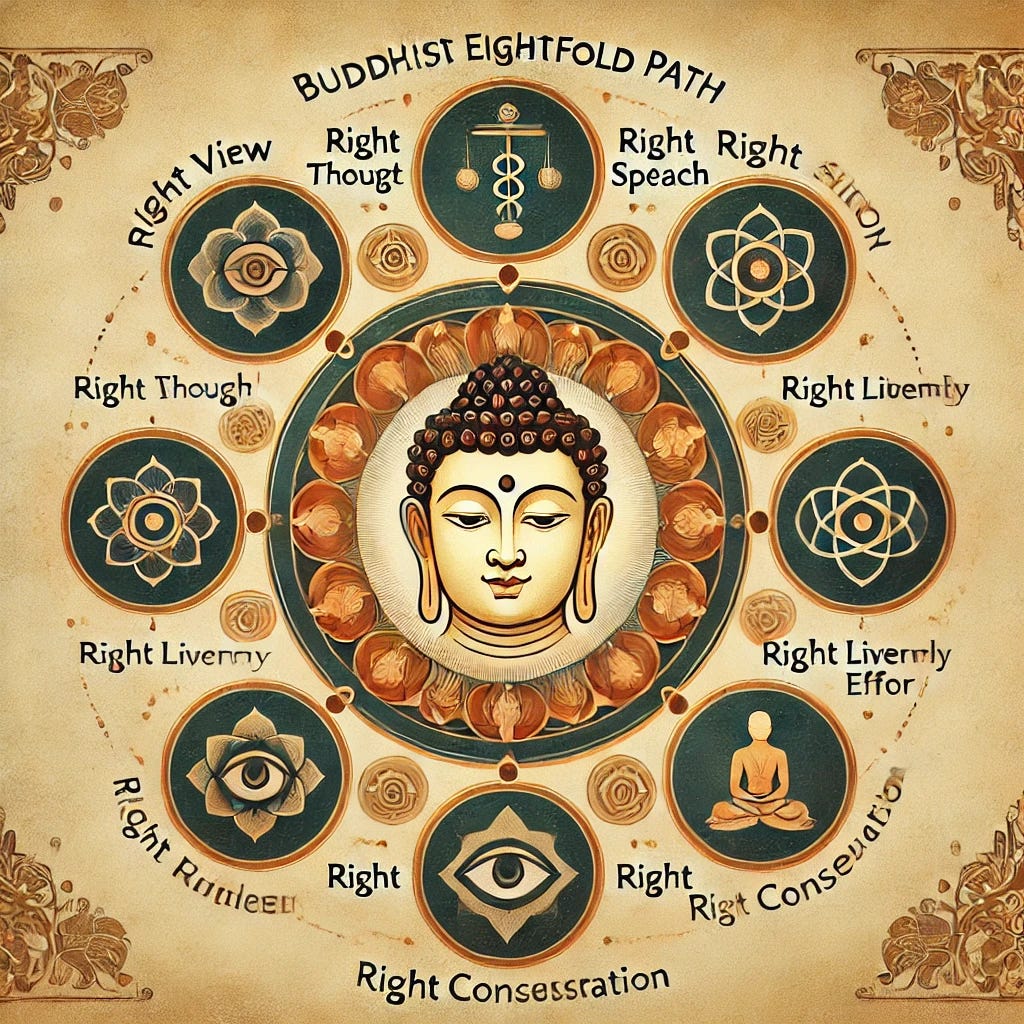
The Eightfold Path
Case Study
The Law of Constant Change
The Law of Constant Change, also known as the principle of impermanence, states that everything in existence is in a perpetual state of flux, cycling through stages of birth, growth, decline, and ultimately, death. This constant transformation can be visualized as a film projected onto the screen of time, with all beings and phenomena constantly changing. Indeed, time itself is linked to this inherent characteristic of impermanence. However, within this ever-shifting reality, there exists an underlying, unchanging truth—a fundamental reality that persists despite the constant change.
The nature of the soul
The nature of the soul is often debated, with some placing it within the individual mind and others attributing it to the phenomenal world, perhaps arising from the tension between individual freedoms granted by the Buddha. To safeguard against negative influences, it is crucial to maintain a pure and clear mind, free from the "dark, damp areas" that attract such negativity. These mental "cancer cells" obstruct the light of Buddha, hindering the soul's evolution. This evolution is directly linked to the soul's capacity to receive and radiate this light. Just as a clear window allows light to pass through, a pure mind allows Buddha's light to illuminate the soul. In contrast, disharmonious thoughts create inner darkness, making it difficult to connect with others on a spiritual level. Cultivating a mind as resilient as steel, capable of withstanding life's hardships, is a key step towards achieving the state of an Arhat—a being of perfection and enlightenment. This state, like polished metal, requires constant self-reflection to remove any "rust" and maintain its brilliance.
Human Mind
The human mind is like a compass, its needle being our thoughts. This mental needle swings constantly, pointing in countless directions throughout the day, rarely finding stillness. Even in those dedicated to spiritual discipline, such as monks, the needle may flicker – perhaps at the sight of beauty, a tempting meal, or the perceived spiritual progress of another. The challenge, and the path to true faith, lies in stilling this restless needle, cultivating an unshakable mind that remains steadfast amidst the constant flux of thoughts and sensations.
The Eightfold Path
The Eightfold Path in Buddhism can be understood through the lens of love's development:
Right View and Right Speech: These foundational elements cultivate fundamental love, the basis for all other expressions of love. A clear understanding of reality and truthful, compassionate communication naturally lead to a loving disposition.
Right Action and Right Livelihood: These practical aspects of the path foster nurturing love, extending care and compassion to all beings through ethical behaviour and a way of life that minimizes harm.
Right Thought and Right Effort: These internal practices give rise to forgiving love, recognizing the imperfections of oneself and others, and cultivating the strength to let go of resentment and anger.
Right Mindfulness and Right Concentration: These culminating elements bring about love incarnate, a deep, unwavering love that permeates one's being and radiates outwards, embodying the highest expression of compassion and wisdom.
Case Study: Handling Heartbreak with Buddhist Principles
We frequently take love with attachment, mistakenly believing that our happiness is contingent upon another person. This dependency, rather than genuine love, is the root of our suffering. Consider the following points:
Attachment Causes Suffering: The belief that we need someone to be happy is a hallmark of attachment. This creates a fragile emotional state. When the object of our attachment is no longer present, the perceived loss of happiness causes immense pain.
Desire Leads to Dependency: Like an addiction, attachment fuels a craving for the constant presence of the other person. This dependency creates a sense of lack and insecurity, leading to suffering when the relationship ends.
Impermanence is Natural: One of the fundamental truths of existence is impermanence. Everything is in a constant state of flux, including relationships. Trying to cling to something that is inherently impermanent is like trying to hold water in your hand – it's a futile effort that only leads to frustration and suffering.
By understanding the difference between love and attachment, and by acknowledging the reality of impermanence, we can develop a more resilient heart, capable of navigating the inevitable ups and downs of relationships without succumbing to the debilitating pain of heartbreak. This understanding isn't about avoiding love, but about experiencing it in a way that is grounded in reality and free from the suffering caused by attachment.